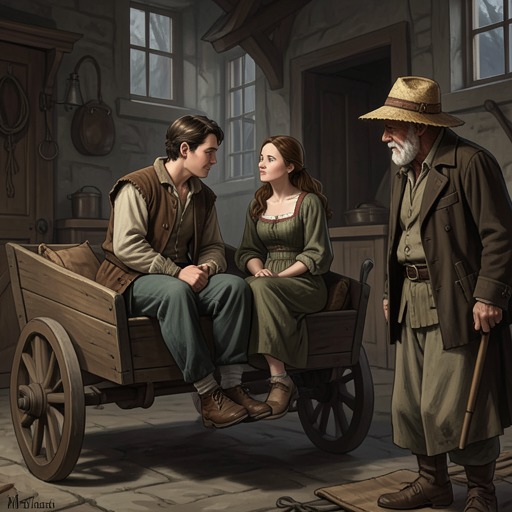
Elin
The EmigrantsElin is the sixteen-year-old daughter of Ulrika of Västergöhl and one of the emigrants traveling from Sweden to North America. Her story joins the collective departure to a more intimate account of inherited stigma, religious conviction, and the effort to imagine a future: on the road and aboard the Charlotta, she begins to speak for herself and to prepare, practically as well as spiritually, for life in an unknown country.
Identity and Background
Elin is identified among the emigrants as Ulrika of Västergöhl’s sixteen-year-old daughter. In the group traveling from Kärragärde, she is one of those who cannot fit on Danjel’s wagon and rides instead with Jonas Petter of Hästebäck. Her position in the party is therefore practical and relational at once: she is a young member of Danjel’s household and religious community, but travels in close company with people beyond her immediate family.
Her departure takes place within a wider movement stirred by news of land across the ocean. The reports reach rural communities through neighbors, but the destination remains unseen and uncertain; familiar home stands against the promise of a place no one in the parish has explored. Elin’s own journey takes shape amid that tension between expectation and apprehension. She is not simply carried along by the collective plan: the uncertainty of America is something she articulates herself.
Elin’s circumstances at home are marked by poverty and by the stigma attached to her mother. She knows that she was born outside marriage and that people have reminded her of this since childhood. Her account of growing up gives the label a material history: when men visited the cottage, her mother sent her outside and locked the door, leaving her to wait in the woodshed during winter wrapped in a warm sheepskin. Food was often scarce. Elin recalls that a visitor sometimes meant food would soon be available, and says the men were not unkind to her, though some mistreated her mother. When one man struck Ulrika, Elin threw a pressing iron at him and helped her mother force him out.
The uncertainty surrounding her father is part of the same history, not a fact Elin can resolve. Her mother thought he might have been a traveling stranger who stayed one night and never returned; she also named the churchwarden Per Persson of Åkerby as a possibility, though neither mother nor daughter wanted him to be the father. Elin prefers the possibility of the stranger, whom her mother remembered as happy and able to play the violin. The narrative makes clear that Elin bears the consequences of other people’s conduct and speculation without having chosen either her parentage or her mother’s circumstances.
The Road to Karlshamn
The emigrants’ departure is organized through a chain of decisions and practical arrangements. Spring offers a chance to cross after the winter storms and arrive in time to till and sow for a first harvest. Karl Oskar and Robert have booked passage on the Charlotta, sending a deposit for six people; Robert offers to obtain a contract for Danjel as well if the ship has room. At Åkerby Junction, the party gathers with the additional travelers from Kärragärde. Nineteen people are present, including three drivers who will return from Karlshamn; the emigrant party itself numbers sixteen, nine adults and seven children.
Elin rides on Jonas Petter’s single-horse wagon, alongside Robert, while Arvid sits behind them. Robert, who had not previously seen Elin at close quarters, notices her long hair and blue eyes, but also recognizes the social judgment surrounding her mother. Their cramped seating brings them physically close as the wagon moves over the road. Elin stays quiet, and Robert does not initially know how to speak to her. Jonas Petter later explains that no one knows for certain who Elin’s father was; the rumors have attached an ethnic slur to the uncertainty. Robert is embarrassed and stops trying to make light conversation.
The small basket on Elin’s knees makes the scale of her departure visible. She holds its handle tightly; to Robert it seems too small for an emigration, but he understands that it may contain all she owns. Her dark dress had belonged to Inga-Lena and is too large for her. These details distinguish Elin’s migration from an abstract passage toward opportunity: she sets out with scant possessions, while carrying the accumulated vulnerability of a childhood in which food, privacy, and social standing were uncertain.
Elin belongs to the Åkians. Ulrika had permitted Danjel to confirm her, and Elin herself escaped punishment for the unauthorized Communion because she was under age. Her religious affiliation accompanies her into the journey and shapes what she expects from it. Danjel has told the believers that they will receive the Holy Ghost and speak the language of their destination, as the apostles did at Pentecost. Elin believes this promise literally, and Robert is struck by the trust with which she repeats it. Her faith is not merely a background detail: at first it offers a direct answer to the practical obstacle of language.
Fear, Memory, and Voice
Elin’s confidence in religious instruction does not mean she is unafraid. Before Robert can explain what he knows about the United States, she confides that she fears America because it is unknown and because newcomers may be treated unkindly. The confession gives her migration a personal edge: the New World is not an uncomplicated promised land to her, but a place whose welcome cannot be guaranteed. Her fear sits beside, rather than cancels, her belief that the Holy Ghost will provide the language she needs.
On the ship, Robert’s private reflections show that he has few chances to speak with her. He remembers being alone with her in Karlshamn, but aboard the Charlotta she is often called away by her mother. He also recalls that when he once said he felt sorry for Ulrika, Elin seemed hurt and replied that he should feel sorry for himself, living in the flesh. Robert does not understand the rebuke. The exchange exposes a limit in his sympathy: he intends kindness, but his pity risks reducing Ulrika and Elin to the parish’s judgment of them.
Elin’s own recollection supplies the correction. She has not forgiven Robert for what he said about her mother, because he does not know the life he is commenting on. She insists that her mother has always been good to her, even while describing hardship and the circumstances of the men who visited the cottage. Her account is neither a simple defense of everything that happened nor an adoption of the community’s condemnation. She recalls that, as a child, she once misunderstood what she heard during one of those visits and thought badly of her mother; after Ulrika explained what people had done to her, Elin never again thought ill of her. Ulrika cried as she told the story, a rare break in the daughter’s memory of her mother’s composure.
Elin’s voice also distinguishes what she knows from what remains uncertain. She can speak clearly about her childhood and her attachment to Ulrika, while her father’s identity stays unresolved. In the same recollection she describes a dream in which her mother plants a white China lily: it grows up to heaven, where God takes it, and its blackened stalk is left in earth that becomes a grave. Elin wakes with the understanding that she herself is dead and buried. The dream joins images of growth, loss, and the grave, but the evidence does not turn it into a literal prediction; it belongs to the emotional and religious landscape through which Elin understands herself.
Learning a Future
Aboard the Charlotta, Robert and Elin sit together on the afterdeck to read an English textbook he bought in Karlshamn. Its title promises guidance for immigrants, but its elementary pages prove difficult for Robert, who has managed only three in several weeks. Their study is a modest, repeated task rather than an instant transformation. It places the two young emigrants side by side as learners, making language a shared preparation for the life that awaits them ashore.
By the approach of land, Elin asks Robert whether they can read the language book. Her eagerness marks a change from the earlier confidence that believers will be given English upon arrival. Robert has reminded her that the apostles’ gift took place before America and before English existed, and he questions whether that miracle can simply be expected to recur in the same way. Elin’s renewed interest in study does not require the narrative to declare her faith abandoned; it shows her making room for preparation alongside belief.
The textbook gives their learning a concrete purpose. Robert wants to tell Americans that he is accustomed to farm work and to earn their respect from the first day. Elin, who has worked as a nursemaid in Ljuder, has now passed sixteen and hopes for a position in America more suited to a grown woman. He urges her to learn the chapter on ordinary household chores, which sets out a maid’s day, including rising, making a fire, boiling water, sweeping, clearing the table, and washing hands before handling food. As Elin reads, she looks at her own clean hands. The lesson links an imagined future occupation to the immediate fact of her preparation, while showing that the prospects she and Robert anticipate remain shaped by labor.
Their work on the language is persistent and self-conscious. The deck rolls beneath them as the sea carries them toward a New World, and they sound out sentences aloud, trying to pronounce them correctly. The two lines they practice identify each young person in terms of work: Robert as accustomed to farm labor, Elin as a new servant girl. They hope their English will make Americans understand what they can do and treat them with respect. Elin’s arc therefore remains open at the point where the supplied evidence ends: she has not yet arrived or secured a position, but she has moved from fear and reliance on promised fluency toward active preparation for the encounter.